
Why does this matter to me?
If you have an inherited anaemia (sickle cell disease, thalassaemia or one of the rare inherited anaemias), your care is probably shared between more than one hospital – a local team you see often, and a specialist team you may see rarely or have never met at all.
That arrangement can be confusing, nobody usually explains it, and understanding it puts you in a much stronger position to ask for what you need.
Inherited anaemias in England are looked after by a national network. This includes sickle cell disease, thalassaemia, and rare inherited anaemias – CDA, DBA, pyruvate kinase deficiency, sideroblastic anaemias, membrane disorders and the rest. If you have a rare anaemia, you are part of this network too.
How is it organised?
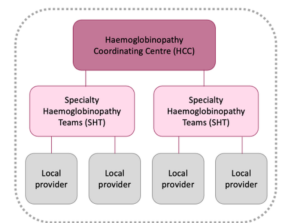
The network has three levels, and you may hear all three mentioned.
Local Haemoglobinopathy Teams (LHTs) are your local hospital. This is where most day-to-day care happens: routine appointments, blood tests, transfusions, and the people you will phone when something is wrong. There are many LHTs across the country.
Specialist Haemoglobinopathy Teams (SHTs) are larger centres with consultants and nurses who have particular expertise in these conditions. They may see you directly, or advise your local team about your care, or both. Some people are seen mostly at an SHT; others see one occasionally.
Haemoglobinopathy Coordinating Centres (HCCs) sit above both. An HCC does not usually see patients itself. It coordinates a region – making sure the local and specialist teams work to the same standards, supporting them with training and advice, and taking a view across the whole region rather than one hospital at a time.
Above all of this, NHS England commissions the service. That means it decides what the network must provide, funds it, and holds it to those standards.
There are also a few national bodies that sit alongside the network rather than above it. The National Haemoglobinopathy Panel (NHP) is a national expert panel that gives advice on the most complex cases in the country – your team can bring a question to it. The National
Haemoglobinopathy Registry (NHR) is the national database, described further below. You will probably never deal with either directly, but they are part of why the system works.
How the levels fit together
Two things are important to understand:
Specialist advice flows down, and complex questions flow up. You do not have to work your way up the levels yourself. If your local team meets something they have not seen before, the structure exists so that they can reach expertise on your behalf – and so that the answer comes back down to them. If a question is complex enough, it can go to the national panel.
Most people stay near the bottom, and that is the design working. The great majority of care happens locally, which is where it should happen. Being seen at your local hospital is not a sign that you are missing out on the specialist end of the network; it is a sign the network has decided your care can be delivered close to home, with expertise available behind it.
The diagram shows the levels, but not the geography. For thalassaemia and rare inherited anaemias the coordinating centres cover much larger areas than they do for sickle cell – so your HCC may not be the one nearest to you. The next section explains this.
The bit that confuses everybody
Here is the thing that catches people out, and it is worth knowing before you go looking for your centre.
The regions for sickle cell disease and the regions for thalassaemia and rare anaemias are not the same. There are ten coordinating centres for sickle cell, and only 4 covering thalassaemia and rare inherited anaemias across bigger areas.
Sickle cell disease is much more common than the rare anaemias, so it needs more centres closer to more people. The rare anaemias are rare enough that expertise has been deliberately concentrated in fewer places covering wider areas.
The practical consequence: if you have CDA, DBA, PKD or a similar condition and you go looking for the coordinating centre for your region, you may find one that says it covers sickle cell – and yours may be somewhere else entirely, possibly a long way away.
If you are not sure which network you are in, ask your haematology team: “Which HCC covers me for my condition, and which SHT am I linked to?” They will know, or they will find out. It is a completely reasonable question and it is not a complaint.
What should I expect from the Network?
The network exists so that where you live matters less. In practice you should be able to expect:
Care that follows national standards rather than one consultant’s preference. Your local team having somewhere to turn when something unusual happens. Access to specialist opinion without having to fight for it. A route to complex treatments – transplant, gene therapy, clinical trials – if they become relevant to you.
If you are moving house, going to university, or travelling within the UK, the network is also how your care follows you. Tell your team in advance rather than after the fact.
What is the National Haemoglobinathy Registry?
The National Haemoglobinathy Registry (NHR) is the national database of people in the UK with inherited anaemias – including the rare ones. It exists so that the NHS knows how many people have these conditions, where they are, and how they are doing.
That matters more than it sounds. Rare conditions are easy to overlook when services are planned and funded. A condition that cannot be counted is a condition that can be argued out of existence at a commissioning meeting – and the registry is how the case gets made instead. It is also how research studies find enough people to be worth doing, and how the network can tell whether care is actually equal across the country or only meant to be.
If you have a rare anaemia, this is the mechanism that makes you visible. It is not a formality.
If you are not sure whether you are on it, ask your team. If you are not on it and would like to be, ask them about that too.
What if I don't think I'm getting specialist care?
This happens, and it is worth saying out loud rather than leaving people to wonder.
Rare anaemias are rare. A general haematologist may see one case of your condition in a career, and may be managing you perfectly reasonably while still not knowing what a specialist would know. That is not a criticism of them – it is arithmetic.
You can ask to be referred to a specialist centre, or for your case to be discussed with one. You do not need to be dissatisfied with your current team to ask, and asking is not a criticism of them. Shared care – your local team plus specialist input – is how this network is designed to work.
Ways to raise it that tend to land well:
“Which specialist centre covers my condition, and are we linked in with them?”
“Would it be worth getting a specialist opinion, even just once, to make sure we’re not missing anything?”
“Could my case be discussed at the network meeting?”
Most haematologists will welcome this. Managing a condition you rarely see is uncomfortable, and a specialist opinion helps them as much as you. If you meet resistance, you can contact the coordinating centre yourself and ask how referrals work – and you can ask your GP to refer you.
What about Scotland, Wales and Northern Ireland?
The structure described here is the NHS England arrangement. Scotland, Wales and Northern Ireland organise their services differently, though specialist centres and referral routes exist in each. If you are outside England, ask your haematology team which specialist service covers your condition.
What can I do to help myself or my child?
Find out which SHT and HCC you are linked to, and write it down. Keep it with your other medical information.
Ask whether you are on the National Haemoglobinopathy Registry.
If you move, tell your team before you go, not after.
Ask for a copy of your clinic letters. They are the thing that travels between hospitals, and having your own set is genuinely useful when you end up somewhere new – particularly in an emergency, when the receiving team may know nothing about your condition.
If your care feels fragmented – nobody quite in charge, tests repeated, advice contradicting itself – say so. That is precisely the problem the network was built to fix, and your team would rather know.
Understanding how the service is organised is not just administration. It is how you get the right care from the right people – and how you ask for it when you are not getting it.